Valuation
How Much Is an HVAC Business Worth in 2026?
ContractorExit Editorial Team
In-house editorial · 22 Jun 2026 · 11 min read
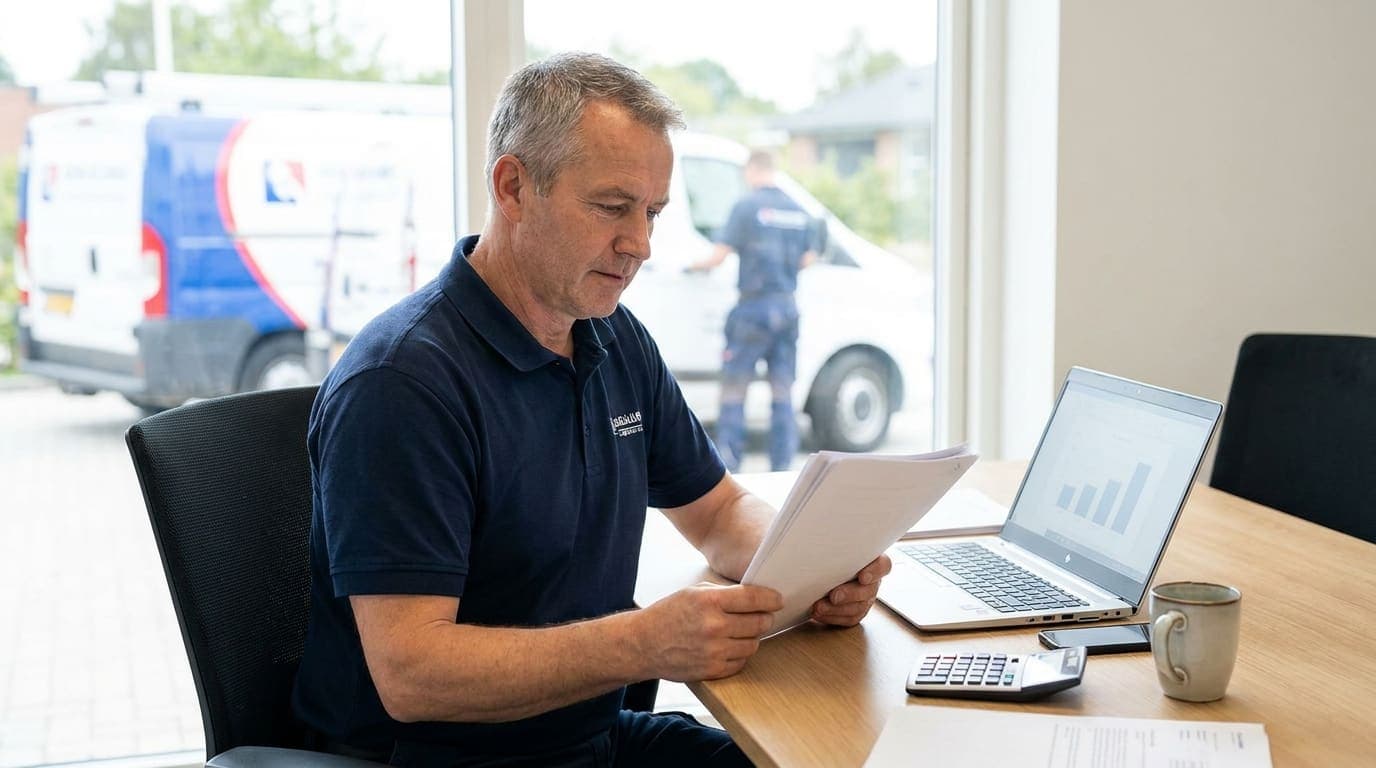
How much is an HVAC business worth? Small shops sell at 2x-3.5x SDE, established firms at 5x-7x EBITDA - the maintenance agreement base drives the gap.
If you want to know how much is an HVAC business worth, here is the direct answer: small owner-operated HVAC shops typically sell for 2x to 3.5x Seller's Discretionary Earnings (SDE), established residential service businesses with $500,000 to $1M in EBITDA attract multiples of 5x to 7x EBITDA from financial buyers, and large platform deals push well past 10x EBITDA. According to BizBuySell data, the average cash flow multiple for HVAC businesses sold on their marketplace runs at approximately 2.79x SDE. The median sale price for HVAC businesses has risen steadily over the past five years as private equity competition for trade businesses intensifies - and for the right business, the numbers are compelling.
But here is the critical detail most HVAC owners miss: two businesses with identical revenue can sell for wildly different prices. An HVAC company doing $1.5M in revenue with no maintenance agreements, an owner who handles every service call personally, and books that need explaining is worth a fraction of an HVAC company doing the same revenue with 40% under service contract, a crew that runs independently and three clean years of financials. Same revenue. Potentially double the price. The difference is the maintenance base - and everything this guide covers below.
HVAC business valuation: what the current multiple ranges actually look like
HVAC businesses are among the most actively transacted in the home services sector. The buyer pool ranges from owner-operators funding an SBA loan to private equity platforms willing to pay premium multiples for the right business. Understanding where your business sits in that spectrum is the first step in getting the number right.
Small and main-street HVAC: 2x to 3.5x SDE
Most HVAC businesses sold at the main-street level - those with under $500,000 in annual SDE - are valued on SDE and trade in a 2x to 3.5x range. According to BizBuySell, the average cash flow multiple for HVAC transactions on their platform is approximately 2.79x SDE. A business at 2x is typically owner-dependent, project-heavy and lightly documented. A business at 3x to 3.5x has some recurring maintenance revenue, a lead technician who manages daily work and clean enough books to pass a buyer's due diligence without friction.
On a business generating $300,000 SDE, the difference between 2x and 3.5x is $450,000. That is the financial case for preparation - and the reason the multiple, not the earnings number, is where owners should focus their attention in the years before a sale.
Established residential HVAC: 5x to 7x EBITDA
Once an HVAC business reaches $500,000 to $1M in EBITDA - which typically means $2M to $5M in revenue with strong service agreement coverage - the buyer pool shifts. Financial buyers, search fund operators and PE-backed add-on platforms become competitive. According to First Page Sage's Q1 2025 HVAC EBITDA Multiples Report, residential HVAC businesses under $1M in EBITDA are trading at 6.1x to 6.3x EBITDA in active processes. Commercial HVAC in the same size band runs slightly lower, at 5.2x to 6.0x EBITDA, reflecting the longer sales cycles and contract tendering risks of commercial work.
At this tier the valuation shifts from SDE to EBITDA because the buyer is not replacing the owner - they are buying a managed business with professional operating capacity. The earnings base is lower (management salaries stay in the calculation), but the multiple applied is higher, and the total outcome for a well-prepared seller is often significantly better than a pure SDE calculation would suggest.
Platforms and roll-up targets: 7x to 13x+ EBITDA
HVAC businesses with $3M to $10M in EBITDA are direct targets for private equity roll-up activity. According to PKF O'Connor Davies' US HVAC M&A Industry Update from Summer 2025, mid-market multiples in this size range are trading at 7x to 10x EBITDA in competitive processes. Larger regional platforms with $10M to $25M in EBITDA are attracting 9x to 13x EBITDA from well-capitalised buyers seeking geographic coverage or service line expansion. These businesses are not in scope of a typical main-street sale - but the PE competition they generate lifts the floor for every HVAC business in the market beneath them.
Why maintenance agreements are the single most important valuation driver
No factor moves an HVAC business's value more than the maintenance agreement base. According to deal data aggregated by BizBuySell, HVAC companies with 40% or more of revenue under service agreements command a 0.5x to 1.0x higher earnings multiple than installation-dependent businesses of the same size. That premium reflects a fundamental difference in what a buyer is actually purchasing.
A business with a strong service agreement base offers:
- Predictable annual revenue. A customer on a $300-per-year service plan generates known income before the season starts. A business with 800 active service agreements carries $240,000 in committed annual revenue before a single install job is booked.
- Preferential access to equipment replacements. Service agreement customers replace their systems through the HVAC company they trust, at margin rates that cold-call install work cannot match.
- Lower customer acquisition cost per dollar of revenue. Retaining a maintenance customer is far cheaper than acquiring a new install job. A robust agreement base signals a business that compounds, not one that must constantly refill the pipeline.
- Reduced weather and seasonality risk. Maintenance calls run year-round. A business with no service base lives and dies on installation demand, which is seasonal and weather-dependent in most US markets.
The contrast in value is stark. Two residential HVAC businesses, both at $350,000 SDE:
- Business A - no maintenance agreements: All revenue from new installs and reactive repair calls. Lumpy, seasonal, owner-dependent. At 2.25x SDE: approximately $787,500.
- Business B - 45% recurring: 650 active service agreement customers, one commercial property management contract, crew leader handling scheduling. At 3.5x SDE: approximately $1,225,000.
Same earnings. Same trade. $437,500 difference. The maintenance agreements did that.
A worked valuation example with real numbers
Here is how the valuation calculation works in practice on a real main-street HVAC business:
- Revenue: $1,850,000
- Net profit on the P&L: $130,000
- Owner's salary drawn: $95,000
- Owner's vehicle fully expensed: $18,000
- Owner's phone, health insurance and personal travel: $12,000
- One-off equipment purchase not recurring: $22,000
- Seller's Discretionary Earnings (SDE): $277,000
That $277,000 SDE is what a buyer pays a multiple of - not the $130,000 net profit, and not the $1.85M in revenue.
At 2.5x multiple, the business is worth approximately $692,500. At 3.2x - achievable if the maintenance agreement base covers 35% of revenue, a lead tech runs daily ops and the books are clean for three years - the same business is worth approximately $886,400. The $194,000 difference is entirely the result of preparation, not of working harder or taking more jobs.
Five factors that move an HVAC business up the multiple range
The gap between 2x and 3.5x SDE is not random. These are the specific factors the market rewards:
1. Maintenance agreement base
As covered above, this is the primary multiple driver. A documented, actively renewing service agreement program - with actual renewal rates you can show a buyer - justifies a premium every time. If you do not have one, building it is the highest-return investment you can make before a sale.
2. Owner independence
A business where the owner handles all customer relationships, equipment recommendations and escalated service calls is a business that depends on the owner staying. Buyers discount for this because they carry the risk that relationships leave with the seller. A lead technician or operations manager who runs the day-to-day independent of the owner is worth real money at sale time.
3. Clean, verifiable financial records
Three years of accounts that reconcile to bank statements, where add-backs are documented and defensible, speed due diligence and reduce buyer anxiety. HVAC businesses have several legitimate add-backs - owner's truck, tools expensed personally, health insurance - but they need clear documentation so a buyer can accept them without starting from a position of distrust.
4. Transferable technician licensing
EPA Section 608 certifications, state contractor licences and any locally required trade permits need to transfer with the business or be replicable in the new owner's structure. A business where the primary HVAC contractor licence is held personally by the owner and cannot be transferred creates a material risk that informed buyers price conservatively. Resolving the licence structure before going to market removes a negotiating discount that should not exist.
5. Diversified customer base
No single customer or commercial account should represent 30% or more of HVAC revenue without a long-term contract in place. Customer concentration is a standard item in buyer due diligence and one of the most common reasons for a price chip. Residential maintenance businesses with hundreds of individual customers are inherently diversified - and the market rewards it.
What kills value in an HVAC business
Every factor above, inverted, is a discount. Some specifics to the HVAC sector:
- Heavy new construction dependency. HVAC businesses whose revenue is primarily tied to residential or commercial new construction face buyer skepticism about revenue quality. New construction revenue is builder-dependent, spec-driven and tied to housing market cycles. No maintenance base and no direct homeowner relationships means no annuity - and buyers price that risk heavily.
- Storm-season revenue spikes. A single year of unusually high revenue from storm-season replacement demand flatters the SDE but does not represent the steady-state business. Buyers will normalise for abnormal years, and owners who anchor on peak years in their valuation expectations often find the market uses a different base.
- Equipment and fleet age. An aging van fleet, outdated diagnostic equipment or shop tools past their serviceable life creates a capital expenditure liability the buyer absorbs. Experienced buyers estimate the catch-up cost and deduct it from the offer, so deferred maintenance on equipment directly reduces what you receive.
- Technician turnover. EPA-certified, experienced HVAC technicians are difficult to recruit and slow to train. High staff turnover signals something is wrong with the culture, compensation or systems - and raises the risk that the business cannot sustain revenue through the ownership transition.
- Unresolved licensing. Any ambiguity about whether the existing contractor licence transfers, or how long it would take a new owner to obtain one independently, introduces deal risk that conservative buyers price into their offer. Resolve it before going to market.
The buyer pool for HVAC businesses today
Understanding who is buying HVAC businesses - and what each buyer type pays - is as important as getting the SDE calculation right.
Individual owner-operators are the largest buyer pool by number. They fund acquisitions with SBA 7(a) loans, which require approximately 10% equity injection and a debt service coverage ratio of 1.25x. That arithmetic constrains what they can responsibly pay, which is why most owner-operator purchases close in the 2x to 3.5x SDE range regardless of business quality. The ceiling is set by the debt structure, not by enthusiasm for the business.
Private equity and PE-backed platforms are active consolidators in the HVAC sector. IBBA Market Pulse data from Q4 2025 confirms that Construction and Engineering represented the most active Lower Middle Market deal category, with significant rollup activity. These buyers work in EBITDA and leverage, pay multiples individual buyers cannot match, and are largely targeting businesses with $500,000 or more in EBITDA. According to PKF O'Connor Davies, well over 150 HVAC acquisitions were completed by PE-backed platforms in H1 2025 alone.
Local competitors and strategic buyers - existing HVAC businesses acquiring a competitor's customer base, geographic coverage or technician team - represent a smaller but active buyer segment. They can pay differently because the acquisition creates synergies, but they move more slowly through diligence and can create confidentiality risks if approached before a proper process is in place.
For a $400,000 SDE HVAC business, the ideal outcome is often not selling to the buyer who found you first - it is running a process that surfaces multiple interested buyers simultaneously. Competition is what gets you to the top of your multiple range rather than the middle of it.
What to do if your valuation is lower than you expected
If the number you calculated is lower than the one you had in mind, most of the factors that determine it are within your control - given time. The HVAC businesses that achieve top-of-range multiples are not born that way; they are built that way in the two to three years before they sell.
The practical playbook:
- Launch a maintenance agreement program now. Even 12 months of building an active service agreement base meaningfully changes the revenue quality story you can show a buyer. Offer a competitive annual agreement to every customer in your service history file.
- Promote your lead tech to operations manager. Give them P&L visibility, customer escalation authority and accountability for scheduling. The day you can take a two-week holiday and the business runs fine is the day your multiple moves.
- Run three clean fiscal years. Work with a bookkeeper or accountant to reconcile your records, document your add-backs and separate personal from business expenses. The track record you build now is the one a buyer will bank on.
- Reduce customer concentration. If one builder, property manager or commercial account represents 30% or more of your revenue, actively diversify. Add residential maintenance accounts, a second commercial customer segment or a service line that draws a different customer type.
For a business doing $300,000 SDE, moving from 2.5x to 3.5x with two years of preparation is worth $300,000 in additional proceeds. On a $400,000 SDE business, the same move is $400,000 more at closing. No other investment you make in your HVAC business comes close to that return.
To understand how HVAC valuation fits into the broader framework for blue collar businesses, read the complete guide to blue collar business valuation - it covers the SDE methodology, the crossover to EBITDA, and why different trades command different multiples. When you are ready to find out what your specific HVAC business would achieve in today's market, start with the free valuation tool for an instant estimate based on real transaction data. Or browse what HVAC businesses are currently selling for on the marketplace to benchmark your situation against live comparable transactions.
Frequently asked questions
What is the average multiple for an HVAC business?
According to BizBuySell data, the average cash flow (SDE) multiple for HVAC businesses sold on their platform is approximately 2.79x. Main-street owner-operated HVAC businesses typically trade between 2x and 3.5x SDE. Businesses with strong maintenance agreement bases and $500,000 or more in EBITDA attract 5x to 7x EBITDA multiples from financial buyers and PE-backed platforms.
How do I calculate what my HVAC business is worth?
Start with your net profit, then add back your owner salary, personal expenses run through the business (vehicle, phone, health insurance) and one-off costs a new owner would not repeat. That adjusted figure is your SDE. Apply a multiple of 2x to 3.5x depending on recurring revenue, owner independence and book quality. A business with a strong maintenance agreement base and a manager running day-to-day operations can justify 3x to 4x SDE.
Do maintenance agreements increase my HVAC business value?
Yes - significantly. HVAC businesses with 40% or more of revenue under service agreements command a 0.5x to 1.0x higher earnings multiple than installation-dependent businesses of the same size, according to BizBuySell deal data. A strong maintenance agreement base produces predictable recurring revenue that buyers pay a premium for because it de-risks the acquisition and signals business quality beyond a single owner's relationships.
What is the difference between SDE and EBITDA for HVAC valuation?
SDE (Seller's Discretionary Earnings) adds back the owner's salary and personal expenses because the buyer is replacing the owner. EBITDA does not add back the owner's compensation because it assumes professional management stays in place. HVAC businesses under roughly $500,000 in annual earnings are valued on SDE by individual buyers. Above that level - particularly above $750,000 in adjusted earnings - financial buyers and PE platforms shift to EBITDA multiples, which opens a higher-paying buyer pool.
When is the best time to sell an HVAC business?
Operationally, the best time to go to market is when your maintenance agreement base is strong, your lead tech can run the business without you and your books are clean for at least three years. From a market timing perspective, HVAC business demand is currently strong due to PE rollup activity and the BizBuySell data shows consistently rising median sale prices over the past five years. Starting the preparation process two to three years before you want to close gives you the most control over the outcome.
How long does it take to sell an HVAC business?
From initial listing to close, most main-street HVAC business sales take 6 to 12 months. The IBBA Market Pulse reports a median of approximately 170 days from accepted offer to closing. Smaller, cleaner businesses with straightforward financing can close faster. Larger deals involving SBA lending or PE buyers typically run longer due to additional due diligence and lender underwriting requirements.
Thinking about your own exit?
Get a free, instant ballpark valuation - no sign-up to see your estimate - then we connect you with a vetted broker and lawyer to handle the sale.