Buying
How to Buy an HVAC Business
ContractorExit Editorial Team
In-house editorial · 9 Oct 2026 · 11 min read
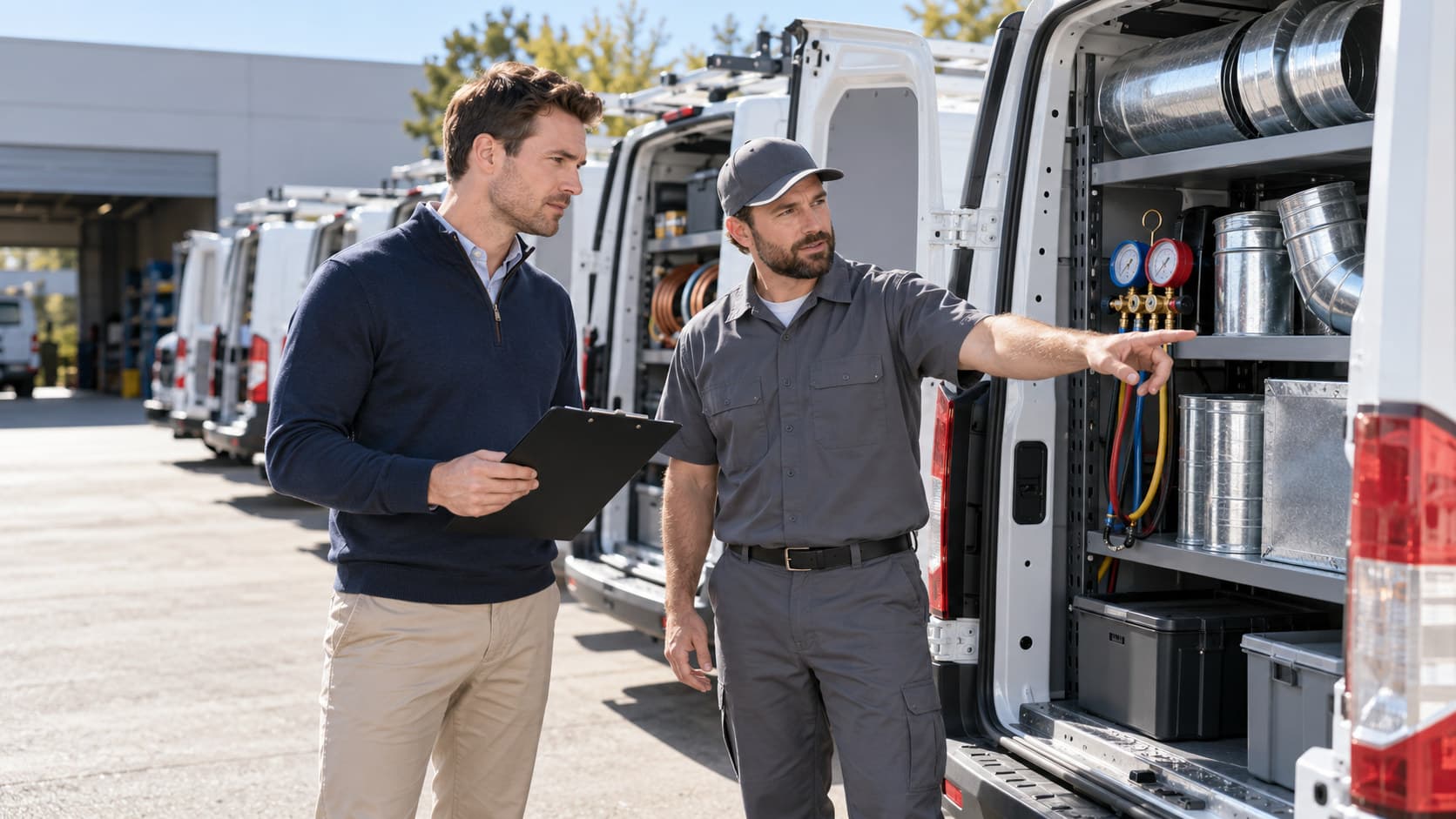
Buying an HVAC business: how private equity prices deals above $500k EBITDA, the multiples below it, SBA financing, diligence and seller notes.
Buying an HVAC business right now means bidding against money you can't match dollar for dollar. Private equity platforms completed 47 sponsor HVAC deals in the first half of 2026 alone, according to Capstone Partners, and 38 of those were add-on purchases folded straight into an existing platform. That's not a reason to stay out of the trade. It's a reason to know exactly where you still have the edge: deals under roughly $500,000 in Seller's Discretionary Earnings (SDE), where the platforms aren't bidding, and sellers who'd rather hand the keys to a person than a spreadsheet. Get the size range right, pay a fair multiple of real earnings instead of revenue, and sort the license and the crew before you sign anything, and buying an HVAC business is still one of the most dependable routes into ownership in the trades.
Buying an HVAC business: why the private equity money changes the game
HVAC is the most actively consolidated trade in home services. Capstone Partners' July 2026 HVAC services M&A update puts sponsor-backed deal volume at 47 transactions year to date, roughly flat with the same point in 2025, and says add-ons made up 41.3% of that activity because the market is still too fragmented for any one platform to mop up. That tells you two things. The buying is not slowing down, and most of it is one platform bolting a smaller company onto a bigger one, not a founder buying their first business.
These buyers are not shopping where you are. PE-backed platforms are largely targeting HVAC businesses with $500,000 or more in EBITDA, the size where the math works for a fund and the seller has a management layer in place already. Below that line, in the main-street range most first-time buyers are actually looking at, the competition thins out to other individuals, a handful of local competitors, and almost nobody wielding institutional money. For the full breakdown of how the multiple ranges split by size, read how much an HVAC business is worth in 2026.
There's a second edge that doesn't show up in any deal report. A fair number of owners you'll talk to have already had a broker or a platform pitch them on selling into a roll-up, and some of them hate the idea. They don't want their name taken off the van, their techs folded into someone else's HR system, or their customers handled by a call center two states away. That seller is not shopping for the highest multiple. They're shopping for the buyer who'll run it the way they did.
You're not trying to out-bid a platform. You're trying to find the seller who was never going to sell to one.
What you're actually paying for
An HVAC business is priced on earnings, not revenue, and the earnings number changes depending on size. Under roughly $500,000 in SDE, main-street HVAC businesses sell for 2x to 3.5x SDE, with BizBuySell putting the average cash flow multiple across its marketplace at approximately 2.79x. Above that, once a business clears $500,000 to $1M in EBITDA with real management in place, the buyer pool shifts to financial buyers and PE add-ons paying 5x to 7x EBITDA, and platform-scale deals above $3M in EBITDA run 7x to 13x according to PKF O'Connor Davies' HVAC M&A research. That top tier is not where you're buying. It's useful only because it tells you consolidators are paying up for size, which lifts demand for everything underneath it.
Run it on a real number. An HVAC business doing $1.2M in revenue with $145,000 in SDE after reasonable add-backs is worth about $362,500 at 2.5x. The same earnings, with a documented maintenance agreement base covering 40% of revenue and a lead technician who runs the schedule without the owner, is worth closer to $507,500 at 3.5x. Same earnings, same trade, a $145,000 gap, and it has nothing to do with how many jobs the business ran that year.
Where to actually find an HVAC business for sale
Three sources do most of the work for a first-time buyer:
- Marketplace listings. Browse HVAC businesses for sale filtered by location and size. Listings are blind by default, so you see revenue, profit and the story before you learn the business's name, which is exactly how an owner who hasn't told staff or customers yet tests the market. See why sellers list this way if it feels unusual the first time you hit it.
- Brokers who actually handle trades. A broker is paid by the seller, but a broker who specializes in home services is also your fastest route to deals that never show up on a public board.
- Direct outreach. HVAC has an aging owner base. A short, respectful note to an owner in his late 50s or 60s who isn't listed anywhere occasionally surfaces someone who's quietly ready, before a broker's commission is baked into the number.
The businesses with a real maintenance base and clean books get bid up fast right now, because there aren't enough of them for the demand. If you find one, move. The ones still sitting at ninety days are usually there for a reason, and that reason is worth finding before you dismiss the listing.
What a good HVAC acquisition looks like
Strip away the pitch and the businesses worth chasing share a short list of traits, every one of them checkable before you make an offer:
- A documented maintenance agreement program, with enrollment numbers and a renewal rate above 70%, not a program that exists only on the sales page.
- Service and maintenance revenue making up 40% or more of the total, rather than two or three builders or general contractors dictating the pipeline.
- A lead technician or operations manager who runs the schedule and handles escalations without the owner on the phone.
- Three years of books that reconcile to the bank statements, not three years of "trust me."
- No single commercial account over 20-30% of revenue.
- A fleet and shop equipment that have been maintained, not run down and due for replacement the month you take over.
The HVAC-specific diligence first-time buyers skip
General diligence, financials, contracts, litigation, applies to every acquisition. Three things are specific to HVAC, and they're the ones that catch buyers who've done this once before in a different trade.
The license and the EPA certification, before you sign anything
In most states the HVAC contractor license sits with the owner personally, not the business entity, and every technician who handles refrigerant needs an EPA Section 608 certification. If the license walks out the door with the seller, the business legally can't perform the work it was bought to do. Before you sign a letter of intent, get a straight answer on four questions: does the license transfer to the entity, will the seller stay on as qualifying party during a transition, can you hire a licensed qualifier, and how long does getting your own license take in that state? None of these kill a deal on their own. All of them are expensive surprises if you learn the answer after you've already paid.
Maintenance agreement enrollment, not just the sales pitch
Anyone can say they have a strong service base. Ask to see the enrollment numbers, the plan terms, and the actual renewal rate, and confirm the agreements are assignable to a new owner without every customer having to re-sign. A business with 800 active agreements at $300 a year carries $240,000 in committed revenue before a single install is booked, and that's exactly the number you should be able to verify, not estimate.
Fleet condition and technician retention
Get the maintenance records on the vans and the diagnostic equipment, not just a walk-around. A fleet that's been deferred for two years is a capital expense you're about to inherit, and it should come off your offer, not out of your pocket after close. On the crew side, EPA-certified technicians with five years of tenure are not easy to replace on short notice. Find out how long the team has been there, how they're paid, and whether anyone has already told the owner they're leaving once the sale closes. If the answer is vague, assume the worst and budget a retention bonus for the two or three people you can't afford to lose.
A licensing lesson from running subcontractors
When I ran my property maintenance company in London, working for housing associations and letting agents through a network of subcontractors, every tradesperson had their qualifications checked before they touched a job, not after. A housing association doesn't care whose fault it is if unlicensed work goes wrong on one of their properties. They care that it happened on your watch. Buying an HVAC business is the same test with a bigger number attached. If you don't check the license and the certification structure before you own it, you find out what's wrong with it on the first call that goes sideways, not before.
Financing an HVAC business purchase
Most buyers don't pay cash, and the SBA 7(a) loan is still the dominant tool. Under the current SBA rules (SOP 50 10 8, effective mid-2025), the minimum equity injection for a first-time buyer is 10% of total project cost, not just the headline purchase price, and lenders can't waive it. A seller note can cover up to half of that injection, but it has to sit on full standby, no principal or interest payments, for the entire life of the 7(a) loan. Expect a credit score around 680 or better and a Debt Service Coverage Ratio near 1.25x, the same math that caps what any SBA-financed buyer can responsibly offer and the reason most owner-operator deals land in that 2x to 3.5x SDE range regardless of how much they like the business.
Seller financing is worth asking for regardless of what the bank requires. The IBBA Market Pulse survey has 62% of business brokers calling it "very important" in the current market, and a seller willing to carry part of the price on top of the SBA structure is telling you, as plainly as a seller can, that they believe the business keeps performing after they leave. Whatever mix you land on, budget separately for working capital. Payroll runs every week whether invoices have cleared or not, and an HVAC business that's profitable on paper can still be tight on cash the month you take over.
Where first-time buyers actually lose money
- Pricing off revenue instead of SDE, because a bigger top line feels safer. It isn't. It's just bigger.
- Signing the LOI before the license question is answered, then discovering the fix takes four months and a lawyer.
- Taking the maintenance-base claim at face value instead of asking for the enrollment and renewal numbers.
- Assuming the crew stays because nobody's quit yet. Nobody quits before the sale. They quit after.
- Underfunding working capital and running out of cushion in month two, before the business has had a chance to prove itself under new ownership.
The first 90 days after you buy
Change nothing visible at first. Keep the branding, the pricing, the van livery and the way the phones get answered exactly as they were. Meet every technician one-on-one in the first week, not in a group meeting. Call the top twenty customers yourself and tell them who you are. Keep the seller reachable through the license transition and use them for it, most sellers who built something real want the handover to go well. The business you bought already works. Your only job for the first three months is to not be the reason it stops.
The bottom line
Buying an HVAC business is still one of the better ways into ownership, essential service, recurring demand, financeable with SBA debt. You're not going to out-bid the platforms chasing $500,000-plus EBITDA businesses, and you don't need to. The deals worth chasing are smaller, the sellers are often happier to sell to a person than a fund, and the businesses worth buying are the ones with real maintenance revenue, a license structure that's already sorted, and a crew with a reason to stick around. Check those three things before you check anything else. For the full acquisition process end to end, read how to buy a blue collar business, and for the general buyer's checklist that applies across every trade, see buying your first trade business. If you're weighing HVAC against another trade, buying a plumbing business runs the same playbook with a different licensing problem. When you're ready to see what's actually on the market, browse live HVAC businesses for sale.
Frequently asked questions
How much does it cost to buy an HVAC business?
Main-street HVAC businesses typically sell for 2x to 3.5x Seller's Discretionary Earnings, so a business earning $300,000 SDE usually costs $600,000 to $1,050,000 depending on the maintenance agreement base. With SBA financing, the minimum cash equity injection is 10% of total project cost, so that deal can close with roughly $60,000 to $105,000 in cash plus working capital, not the full price.
Can I compete with private equity to buy an HVAC business?
Not for the same deals, and you don't need to. PE-backed platforms are largely targeting HVAC businesses with $500,000 or more in EBITDA. Below that, in the range most first-time buyers are actually looking at, the competition is other individuals and local competitors, not institutional money. Some owners also specifically don't want to sell into a roll-up, which works in an individual buyer's favor.
Is buying an HVAC business a good investment?
For the right business, yes. HVAC is essential, recurring demand, and private equity has been actively consolidating the sector, which signals real buyer confidence in the trade. The investment is only as good as the maintenance agreement base and the crew you're inheriting, so the sector's strength doesn't rescue a bad individual deal.
Do I need an HVAC license to buy an HVAC business?
Not always personally, but someone has to hold it. In most states the HVAC contractor license sits with the owner rather than the business entity, so before you sign anything, confirm whether it transfers, whether the seller will stay on as qualifying party during a transition, or whether you need to hire a licensed qualifier. Sort this before the letter of intent, not during due diligence.
How do I find an HVAC business for sale?
Marketplace listings, business brokers who specialize in trades, and direct outreach to owners who aren't actively listed are the three real sources. Most HVAC listings are blind, showing revenue, profit and story without the business name, so you'll usually need to enquire and sign an NDA before you see full financials.
Can I use an SBA loan to buy an HVAC business?
Yes, and most buyers do. The SBA 7(a) loan is the dominant financing tool, with a 10% minimum equity injection calculated against total project cost, a Debt Service Coverage Ratio around 1.25x, and typically a 680+ credit score. A seller note can cover up to half the required injection but must sit on full standby for the entire life of the loan.
Thinking about your own exit?
Get a free, instant ballpark valuation - no sign-up to see your estimate - then we connect you with a vetted broker and lawyer to handle the sale.