Buying
How to Buy a Landscaping Business
ContractorExit Editorial Team
In-house editorial · 12 Oct 2026 · 10 min read
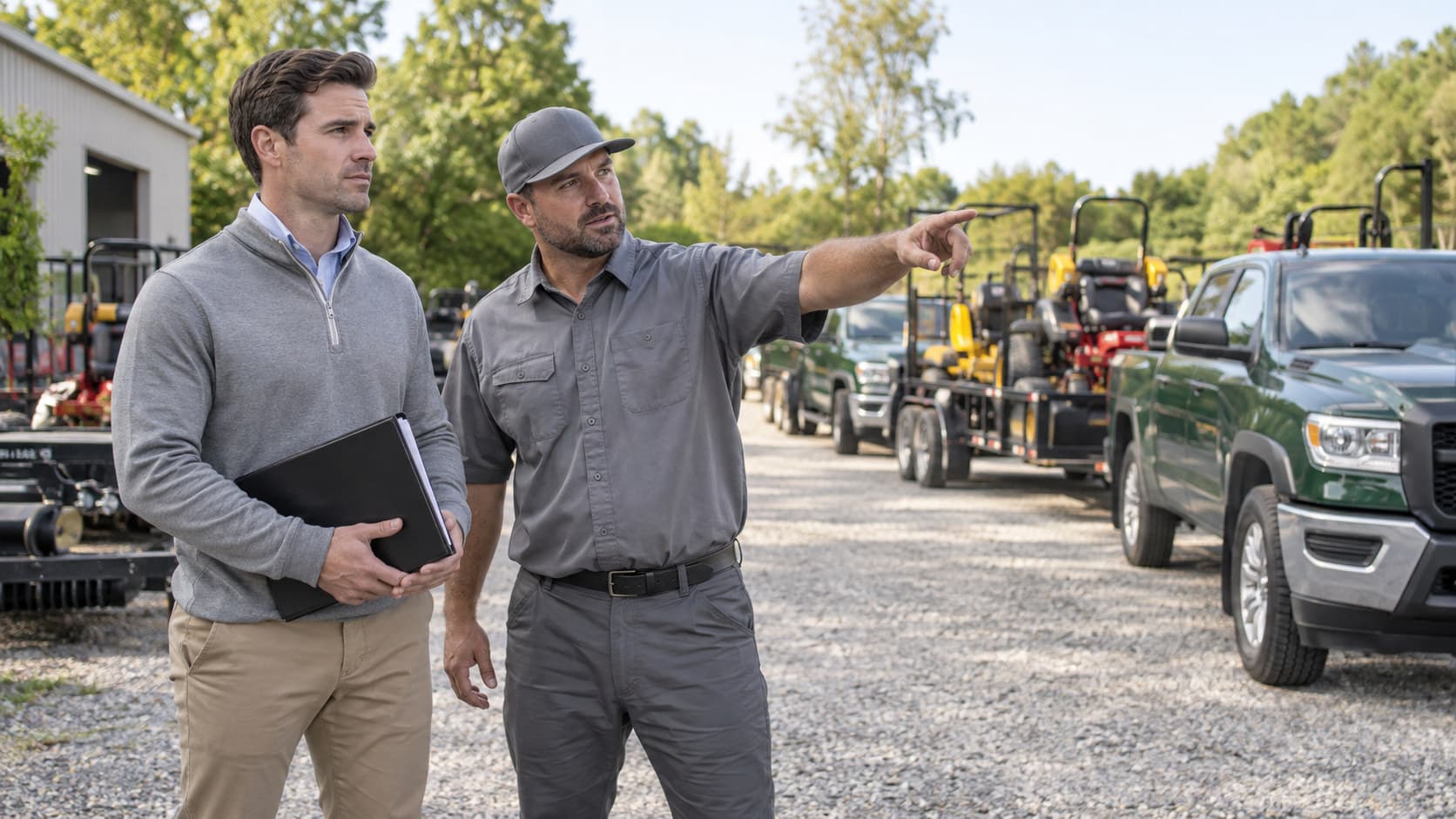
Buying a landscaping business means pricing the contract book, not the trucks, and verifying the recurring revenue actually recurs before you pay for it.
Buying a landscaping business comes down to one number the listing won't hand you straight: how much of that revenue sits under a real contract, and how much just walks out the door with the owner. Most landscaping businesses sell for 2x to 3.5x Seller's Discretionary Earnings (SDE), according to the BizBuySell Insight Report's landscaping and yard service category - a median asking price of $450,000 on SDE that passed $200,000 in 2025. That multiple tells you nothing by itself. Two landscaping businesses with the same revenue and the same profit can be priced $300,000 apart, and the only difference is whether the mowing route renews itself every spring or has to be sold again, one customer at a time. Buy the contract book. The trucks come with it for free.
Buying a landscaping business: why the contract book matters more than the trucks
A landscaping business looks simple from the outside. Mowers, trailers, a couple of trucks, a crew that shows up before 7am. None of that is what you're paying for. You're paying for next year's revenue, and whether it shows up on its own or has to be re-won. A business built on weekly mow-and-blow routes that renew by default every season is a different asset from one built on landscape design and hardscape installs that have to be re-sold job by job, even if both businesses did $900,000 in revenue last year.
For the full breakdown of how that split moves the multiple, read how much a landscaping business is worth. The short version for a buyer: residential and mixed landscaping businesses with no documented maintenance book trade at 2x to 2.5x SDE. Businesses with a real maintenance program, commercial accounts and a renewal rate you can verify push toward 3x to 3.5x. The gap on a $200,000 SDE business is $100,000 to $150,000, and it's decided entirely by paperwork you need to see before you offer, not by anything in the P&L.
What you're actually buying: maintenance route vs design-build
Every landscaping business is a blend of two different businesses wearing one name.
Maintenance route work - weekly mowing, seasonal cleanups, irrigation service, commercial grounds contracts - bills on a schedule whether or not the owner picks up the phone. A customer under an annual service agreement doesn't have to be re-sold every spring; they have to be not lost. Design-build and installation work - patios, planting plans, irrigation build-outs - is project revenue. It has to be won fresh every time, usually off the owner's own reputation and referral network, and it disappears the day the owner stops being the face of the business.
Run the same $900,000-revenue business both ways. With $150,000 in SDE, 70% of it tied up in residential installs and the owner doing every estimate personally, it prices at 2x: $300,000. The same $150,000 in SDE, with a documented maintenance book covering 55% of revenue, two commercial property contracts renewing above 80% a year, and a foreman who runs the schedule without the owner on the phone, prices at 3.25x: $487,500. Same business on paper. $187,500 apart in practice.
You're not buying a lawn care company. You're buying however many of its customers come back without being asked.
How to verify recurring revenue is actually recurring
This is the one step first-time buyers skip, and it's the one that decides whether you overpaid. A seller calling something "recurring" and a customer actually being under contract are two different claims, and only one of them is worth a higher multiple.
- Get the signed agreement, not the customer list. A spreadsheet of names and addresses is a mailing list. A maintenance agreement with a term, a price and a renewal clause is an asset. Ask for the actual documents, not a summary of how many accounts there are.
- Check whether it's assignable. Some maintenance contracts, especially commercial ones, transfer to a new owner automatically. Others require every client to re-sign at the point of sale. A "recurring" book that needs 40 re-signatures the week you take over isn't recurring yet - it's a sales project with your name on it.
- Pull three years of actual renewal data, not the owner's memory of it. A commercial contract renewing at 85% for three straight years is verifiable and valuable. A renewal rate the seller describes as "pretty much everyone stays" is neither.
- Separate commercial from residential. A commercial property management or HOA contract with a multi-year term is a different asset than a residential customer on a month-to-month mow schedule who can cancel with a text message. Price them differently even when they sit in the same revenue line.
- Call a handful of the commercial accounts yourself, once you're under an NDA and the seller agrees. Confirm the contract terms match what you were shown and ask, plainly, whether they plan to renew. Sellers rarely arrange this call unless the answer is good news.
Licensing is more complicated than it looks
Landscaping doesn't have one universal license the way plumbing or electrical work does, which is exactly why buyers skip checking it. Two things catch people out. First, almost every state requires a separate pesticide or herbicide applicator license to legally spray lawns or treat for weeds and pests commercially - if the business runs a chemical treatment program, confirm who holds that license and whether it transfers or has to be re-earned. Second, several states license landscape contracting itself once a job crosses a dollar threshold, usually for hardscape, grading or irrigation installation rather than routine mowing - California's C-27 license is the best-known example. Ask the seller which licenses the business currently operates under, whether they sit with the entity or with the seller personally, and what happens to the chemical program and the installation side of the business on day one if the answer is "me."
A lesson from managing landscaping subcontractors
When I ran my property maintenance company in London, working for housing associations and letting agents through a network of subcontractors, grounds and garden maintenance was some of the easiest work to sell in and the easiest to get wrong on paper. A housing association wanted a signed schedule of works and a renewal date, not a verbal understanding that "we've always done their grounds." The contracts that survived a change of contractor were the ones that were actually written down. The ones that weren't got re-tendered the moment anything changed hands. Buying a landscaping business is the same test. If the maintenance book only exists in the seller's head, it doesn't survive the sale either.
Equipment and fleet: what to actually check
Landscaping is capital-intensive in a way that's easy to underweight next to the contract conversation. Mowers, trailers, trucks, irrigation equipment and hand tools represent real replacement cost, and a fleet that's been run hard with deferred maintenance is a bill you inherit on day one. Get the service records, not a walk-around in the yard. A commercial zero-turn mower has a duty cycle measured in hours, and a seller who can't produce maintenance logs for the fleet usually can't produce them because there aren't any. Price the catch-up cost into your offer rather than discovering it in month two.
Who else is buying landscaping businesses
Private equity has been actively consolidating commercial grounds maintenance. According to KPMG's Fall 2025 facilities services industry update, PE firms accounted for 76% of landscaping services transaction volume through August 2025, and platforms like Verde Equity Partners have been running regional roll-ups, stacking commercial operators such as Juniper Landscape and Green-Tech Landcare onto a single platform. None of that activity is competing with you directly. Those deals target $1M-plus EBITDA businesses with dense commercial route density, a size and profile most first-time buyers aren't shopping in. What it does mean is that the asset class is taken seriously by buyers with real underwriting discipline, which is useful context when you're negotiating with a seller who thinks their mow-and-blow operation should price like a commercial platform.
Financing a landscaping business purchase
Most buyers finance the deal rather than paying cash, and the SBA 7(a) loan is still the standard tool. Under current SBA rules (SOP 50 10 8), the minimum equity injection is 10% of total project cost, calculated on the whole deal rather than just the purchase price, and a seller note can cover up to half of that injection as long as it sits on full standby for the life of the loan. Lenders are underwriting to a Debt Service Coverage Ratio around 1.25x, which is the real ceiling on what any SBA-financed buyer can responsibly offer, regardless of how much they like the business.
According to IBBA and M&A Source's Q2 2026 Market Pulse survey, deals under $500,000 - where most first-time landscaping buyers are shopping - closed with cash making up roughly 88% of the price and seller financing covering most of the rest. The same survey's 2026 chairman, James Parker, put it plainly: at the smallest end of the market, buyers "have more leverage and are more sensitive to financing, margins, and operating risk" than anywhere else in the deal size spectrum. That works in your favor if your financing is actually lined up before you make an offer.
Budget separately for working capital, and budget more of it than you would for a trade that runs flat year-round. Landscaping revenue is seasonal almost everywhere outside the Sun Belt - cash flow that looks strong in July can go quiet from November to March, and payroll for a core crew often has to be carried through the slow months to have a crew left in spring. A business that's profitable on a trailing twelve months can still be cash-tight the exact week you take it over if that week falls in the off-season.
Where first-time buyers lose money
- Paying a maintenance multiple for a mow list. A list of names isn't a contract. If it isn't signed and it isn't assignable, price it like design-build revenue, not recurring revenue.
- Finding the pesticide or applicator license problem after the LOI. If the business runs a chemical treatment program, this should be a same-week question, not a closing-week surprise.
- Underestimating the off-season cash gap. A strong summer P&L hides a thin winter. Model the seasonality before you set your working capital number, not after.
- Assuming the foreman and crew are staying. Nobody quits before a sale closes. Ask directly, and budget a retention bonus for the two or three people the business can't run without.
- Skipping the equipment maintenance records. A fleet that's been deferred for two seasons is a capital expense, not a surprise you discover later.
The first 90 days after you buy
Keep the branding, the pricing and the crew schedule exactly as they were for at least one full season. Meet every crew lead and foreman individually in week one, not in a group announcement. Call every commercial account personally before their next renewal date comes up, introduce yourself, and confirm the contract terms match what you were shown in diligence. Keep the seller reachable through the license transition if there's a chemical program or a contractor license in play. The business already works. Your only job in the first season is to not be the reason a renewal doesn't happen.
The bottom line
Buying a landscaping business is a good way into ownership if you price the contract book honestly and leave the mow-and-blow multiple for the deals that are actually mow-and-blow. The range most first-time buyers are shopping in - main-street deals under $500,000 in value - is exactly where the IBBA says buyer leverage is strongest right now. Use it. Verify the renewal rate before you believe it, check the license before you sign the LOI, and budget for the slow season like it's guaranteed, because it is. For the complete process from offer to close, read how to buy a blue collar business, and for the general buyer's checklist that applies across every trade, see buying your first trade business. If you're weighing landscaping against another trade, buying an HVAC business runs the same playbook against a different licensing problem. When you're ready to see what's actually on the market, browse live landscaping businesses for sale.
Frequently asked questions
How much does it cost to buy a landscaping business?
Main-street landscaping businesses typically sell for 2x to 3.5x Seller's Discretionary Earnings, so a business earning $200,000 SDE usually costs $400,000 to $700,000 depending on how much of the revenue sits under a documented maintenance contract. With SBA financing, the minimum cash equity injection is 10% of total project cost, so that deal can close with roughly $40,000 to $70,000 in cash plus working capital, not the full price.
Is buying a landscaping business a good investment?
For the right business, yes. Landscaping has steady demand, and according to KPMG's Fall 2025 facilities services industry update, private equity has been actively consolidating the commercial side of the sector, which signals real buyer confidence. The investment is only as good as the maintenance book you're inheriting - a business built on project work that has to be re-sold every season is a weaker asset than one with contracts that renew on their own, even at the same revenue.
Do I need a license to buy a landscaping business?
Not always, but check two things before you sign anything. Most states require a separate pesticide or herbicide applicator license for any chemical treatment program, and several states license landscape contracting once a job - usually hardscape or irrigation installation - crosses a dollar threshold. Confirm whether the current licenses sit with the business entity or with the seller personally, and what the transition plan is if it's the seller.
How do I find a landscaping business for sale?
Marketplace listings, business brokers who handle trades, and direct outreach to owners who aren't actively listed are the three real sources. Listings are usually blind, showing revenue, profit and the business model without the name, so expect to sign an NDA before you see the maintenance contracts and full financials.
Can I use an SBA loan to buy a landscaping business?
Yes, and most buyers do. The SBA 7(a) loan is the dominant financing tool, requiring a 10% minimum equity injection calculated against total project cost and a Debt Service Coverage Ratio around 1.25x. A seller note can cover up to half of that required injection, but it has to sit on full standby for the life of the loan.
Is landscaping a seasonal business to buy?
In most of the country, yes, outside the Sun Belt. Revenue and cash flow typically drop from late fall through early spring even when the business is profitable on an annual basis. Budget working capital to cover payroll through the slow months, because a business that looks strong on a trailing twelve months can still be cash-tight the week you take over if that week falls in the off-season.
Thinking about your own exit?
Get a free, instant ballpark valuation - no sign-up to see your estimate - then we connect you with a vetted broker and lawyer to handle the sale.