Buying
Buying a Business vs Starting One From Scratch
ContractorExit Editorial Team
In-house editorial · 19 Oct 2026 · 9 min read
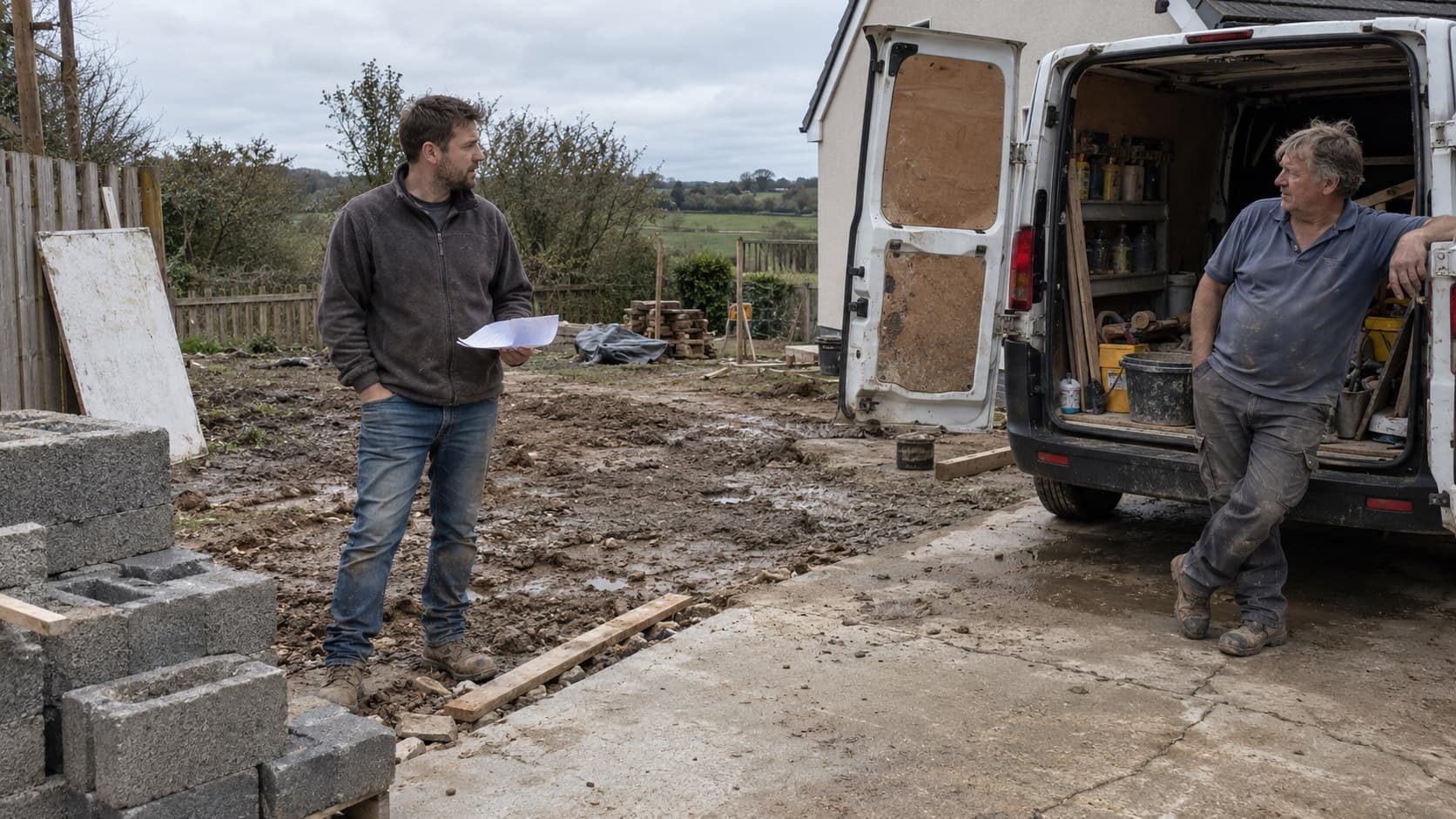
Buying a business vs starting one: buying gets you cash flow and a crew on day one. Starting from scratch costs less, but you're unpaid for a year or two.
Buying a business vs starting one from scratch comes down to this: buying gets you cash flow, a crew and a phone that already rings on day one. Starting from scratch costs less to get in the door, but you're unpaid for a year or two while you build a customer list, a crew and a reputation out of nothing. Neither one is the safe choice. They're just different bets, and most people pick the wrong one because they never ran the numbers side by side.
Buying a business vs starting one from scratch: what you're actually choosing between
When people ask me this, they usually think they're choosing between "safe" and "risky." That's not the real split. The real split is between paying for a running business now, with real revenue already attached, or paying with your own unpaid time later while you build one. Both cost you something. Buying costs cash up front. Starting from scratch costs years.
About one in five new businesses close within the first year, and roughly half don't make it to year five, according to Bureau of Labor Statistics data on business survival. That's not a reason to avoid starting one. It's a reason to know exactly what you're signing up for before you pick that path over the other one.
What you get when you buy: cash flow from day one
A business you buy already has customers, a crew that knows the work, a van on the road and invoices going out next week. You're not hoping the phone rings. It's already ringing. That's the entire case for buying, and it's a strong one: you can draw a wage from month one instead of month eighteen.
Most small trades businesses sell for 2 to 3.5 times seller's discretionary earnings, and that multiple is the price of skipping the years it takes to build that same earnings number from zero. Our full guide to how blue collar businesses actually get valued breaks down why that range moves, but the short version is simple: you're paying for proof the business works, not a promise that it might.
The median small business sale price in the second quarter of 2026 was $349,250, according to BizBuySell's transaction data, and roughly 2,100 trades and small businesses changed hands in that quarter alone. That's not a niche market. There are buyers doing this every week, and most of them aren't buying a dream, they're buying a payroll that's already running.
What buying actually costs you
Buying isn't free money. You need a down payment, and the business needs to carry its own debt afterward, which means you can't overpay just because the seller's story sounds good. An SBA 7(a) loan typically covers most of the purchase price with roughly 10% equity injection from the buyer, often split so half comes from the buyer's own cash and half can sit as a seller note on standby. That still means finding real cash before you close, and real diligence before you sign anything. Skip either step and you've just bought someone else's problem at full price.
Acquisition loans also perform differently from startup loans in the SBA's own data. Loans used to buy an existing business default at roughly 0.7%, versus close to 1.5% for loans used to start a new one, and over 2% for businesses still under two years old. Lenders aren't guessing when they price acquisition debt more comfortably than startup debt. A business with three years of tax returns behind it is a known quantity. A business plan is not.
What you get when you start from scratch: lower cost, full control, no inherited problems
Starting from scratch has its own real advantages, and they're not small ones. You're not paying a multiple on someone else's earnings. You're not inheriting a fleet that's been quietly falling apart, a crew that's half ready to quit, or customers who were only ever loyal to the owner you're replacing. Everything in the business is built your way, on your terms, from the first invoice.
That matters more than people give it credit for. A lot of acquisitions fall apart in the first year not because the buyer overpaid, but because they inherited a mess they didn't see coming during diligence. Starting clean means there's no mess to inherit. There's just the work of building one.
What starting from scratch actually costs you
The cost isn't mainly cash. It's time, and it's unpaid time. You're going to spend 12 to 24 months, sometimes longer, building a customer list, hiring and training a crew, and figuring out which jobs make money and which ones quietly don't, all while the business earns little or nothing. That's the real price of the lower entry cost. You pay it in years, not dollars, and years don't show up on a balance sheet until you're the one living through them.
Here's the part people underestimate most: the skills that make someone great on the tools, a sharp electrician, a reliable plumber, a landscaper who does beautiful work, are not the same skills that get a new business through its first eighteen months. Winning the work, pricing it right, managing cash flow before the invoices catch up, and hiring people who show up, that's a different trade entirely. Plenty of excellent tradespeople have gone broke running a business, not because they couldn't do the work, but because nobody does the work for free while they learn to run a business.
A worked example: the same $400,000 in earnings, two different bills
Say your goal is a trades business throwing off $400,000 a year in seller's discretionary earnings. Here's what each path actually costs to get there.
Buy it: at a 2.5x multiple, that's a $1,000,000 purchase price. With an SBA 7(a) loan structured around a 10% equity injection, you might need roughly $50,000 to $100,000 of your own cash, with the rest financed and a seller note on standby covering part of your contribution. You start drawing income against that $400,000 in month one, minus debt service. The business already has the crew, the customers and the systems that produce that number. Your job from day one is to not break what's already working while you learn it.
Start from scratch: there's no purchase price, but there's also no $400,000 waiting for you. You're building toward it from zero revenue, which typically takes several years of hiring, losing a few customers you shouldn't have, winning some you're glad you did, and slowly turning a one-truck operation into a crew that can actually carry that kind of earnings. Along the way you'll spend real money on a truck, tools, marketing and payroll before the business covers its own costs, commonly tens of thousands of dollars of working capital before you ever draw a full wage yourself. You keep 100% of what you build. You also carry 100% of the years it takes to build it.
Neither number is wrong. They're just paid on different schedules, one in cash at closing, one in unpaid time before the business can pay you anything close to $400,000.
Buying pays for a business that already works. Starting from scratch pays, eventually, for one that might.
The middle path: start lean, buy later
There's a third option that doesn't get talked about enough, and it's the one I actually built my first company around. When I ran my property maintenance business in London, working for housing associations and letting agents, I didn't buy an existing outfit and I didn't buy ten vans and hire a crew before I'd won a single job. I won the work first and subcontracted the labor to tradespeople who already had the tools, the van and the skill. That's the construction arbitrage model: you build the sales and management side first, keep your overhead near zero, and only take on fixed costs once the revenue is proven. Construction Arbitrage has the full breakdown of how that model actually runs day to day.
Done right, it's a way to test whether you can actually win and manage work before you risk real capital on either buying a business or building a traditional one from the ground up. Some people use it as the whole plan. Others use it to build cash and experience, then buy an established business once they've got both. It's not a competitor to buying or starting. It's a way to de-risk whichever one you eventually do.
The question that actually decides it
Forget "safe" versus "risky." Ask yourself these instead:
- Do you have the cash for a down payment? If not, starting lean or subcontracting your way in costs less to begin.
- Can you go 12 to 24 months without the business paying you a real wage? If the honest answer is no, buying something cash-flowing from day one isn't a luxury, it's the only version that works for your life right now.
- Are you better at operating than at selling? Buying hands you an existing book of customers. Starting from scratch means you have to win every single one yourself, from nothing, before you've proven you can run the work.
- Do you want to build the business your way, or run one that already has habits baked in, good and bad? Every acquisition comes with somebody else's decisions already made. Not all of them will be ones you'd have made yourself.
Whichever way you answer, the goal is the same. A business that depends entirely on you working inside it every day isn't really an asset, it's a job with your name on the lease. Our guide on why owner dependence cuts your sale price covers that trap from the selling side, but it applies just as much on day one of ownership. Build or buy with an exit in mind from the start, even if that exit is years away.
The bottom line
Buying a business vs starting one from scratch isn't a question with one right answer. Buying gets you revenue immediately and costs you a multiple of earnings plus the risk of inheriting someone else's problems. Starting from scratch costs less cash and gives you full control, but you pay for it in years of unpaid work while the business barely exists. Know which bill you can actually afford, cash now or time later, and you'll pick the right one for where you actually are, not where you wish you were. For the full process once you decide buying is the move, read our complete guide to buying a blue collar business, then browse live businesses for sale and start running real numbers against real listings.
Frequently asked questions
Is it cheaper to buy a business than to start one?
Not in cash terms, no. Buying usually means a down payment plus financing against a purchase price, often 2 to 3.5 times seller's discretionary earnings for a small trades business. Starting from scratch costs less cash up front, but you pay for that lower price in unpaid time, commonly a year or two before the business earns enough to pay you a real wage.
What is the success rate of buying an existing business compared to starting a new one?
New businesses close at a meaningfully higher rate than acquired ones. About one in five new businesses fail within the first year and roughly half don't reach year five, according to Bureau of Labor Statistics data. SBA loan data tells a similar story from the lender's side: loans to buy an existing business default at around 0.7%, versus roughly 1.5% for startup loans and over 2% for businesses under two years old.
How much money do you need to buy a business instead of starting one?
With an SBA 7(a) loan, buyers typically need roughly a 10% equity injection, and part of that can come from a seller note on standby rather than all cash. On a $1,000,000 purchase price, that often works out to somewhere between $50,000 and $100,000 of the buyer's own cash, plus working capital to cover the first few months.
Is buying a business a good way to become self-employed?
It's one of the fastest ways, because you inherit revenue, a crew and customers instead of building them from nothing. It only works if you do real due diligence first. A cash-flowing business bought without checking the books, the contracts and the team can turn into the slow, expensive version of starting from scratch anyway.
What is the biggest risk of buying an existing business instead of starting one?
Inheriting a problem you didn't see during diligence: a customer base that was loyal to the previous owner personally, a fleet that's been quietly neglected, or a crew that's already planning to leave. The price you pay doesn't protect you from these. Only the diligence does.
Can you combine buying a business with starting one from scratch?
Yes, and a lot of people do it in sequence rather than picking one for good. Some start lean, winning work and subcontracting the labor to build cash and experience without the overhead of trucks and crews, then use that capital and track record to buy an established business later. It's a way to test yourself before you risk real money either way.
Thinking about your own exit?
Get a free, instant ballpark valuation - no sign-up to see your estimate - then we connect you with a vetted broker and lawyer to handle the sale.