Market & data
Lift Maintenance Company for Sale? Why Buyers Want Elevator Businesses Now
ContractorExit Editorial Team
In-house editorial · 22 Oct 2026 · 8 min read
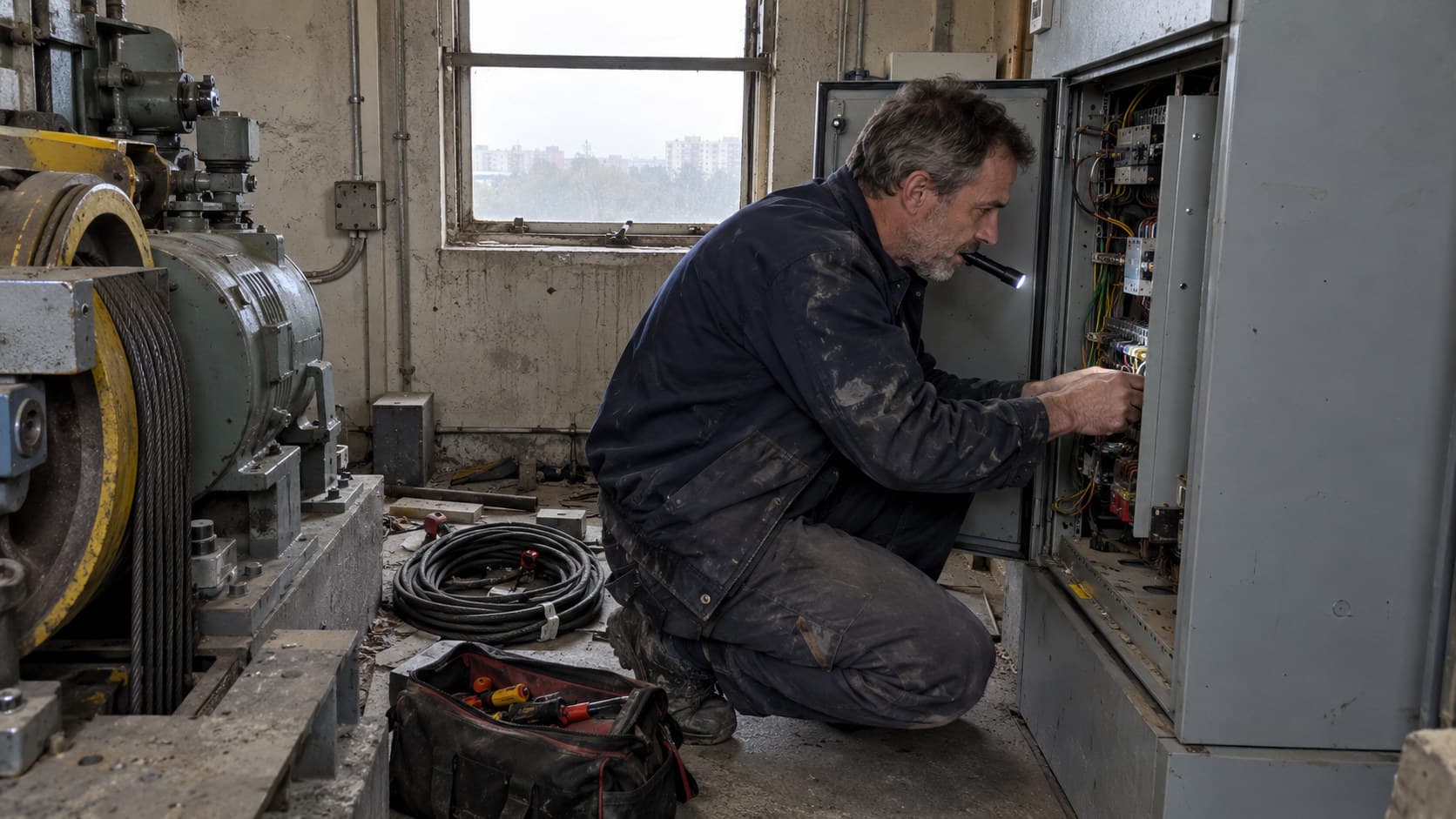
Looking at a lift maintenance company for sale, or building one to sell? The engineer shortage, recurring contracts and what buyers really pay for.
A lift maintenance company for sale is one of the rare trade businesses where demand is locked in by law and labour is scarce in every major market. Lifts have to be serviced and inspected for as long as they run, and qualified engineers are hard to find. That is why buyers pay for these businesses, and why the ones that get built properly are worth building.
Most trade businesses sell jobs. A lift company sells something better: a contract that renews, on a machine that cannot legally be ignored, delivered by people the competition cannot hire. Here is why that matters if you are buying, building or selling.
Why lift and elevator businesses are in demand right now
Three forces, all pushing the same way.
- The work is compulsory. In the UK, the HSE says equipment that lifts people must be thoroughly examined at six-monthly intervals, or under a written examination scheme. Spain brought in a new lift safety instruction on 1 July 2024 (Real Decreto 355/2024) with mandatory safety measures for existing lifts. Building owners do not get to skip this.
- The engineers are scarce. In the US, the Bureau of Labor Statistics counts only about 24,700 elevator installers and repairers in the whole country, with about 1,900 openings a year, mostly to replace people who leave or retire. Otis CEO Judy Marks told Business Insider in May 2026 that the company cannot hire mechanics fast enough.
- The fleet keeps growing. Spain alone runs about 1.2 million lifts, and Feeda, the Spanish lift federation, expects the maintenance and repair side to grow 8-10% by the end of 2026 while new installations stay flat, according to an EFE report from September 2026. The same report says the sector leaves up to 25% of technician posts unfilled.
Compulsory demand plus scarce labour. In any market, that combination is where the margin sits.
In most trades, the client can find another tradesman tomorrow. In lifts, they cannot. That is the whole value story.
What a buyer is really paying for
When someone buys a lift maintenance company, they are not buying vans and tools. They are buying four things.
- The contract book. How many lifts are under maintenance contract, at what monthly price, with how long left to run, and how many renew year after year. Recurring revenue is what turns a trade business from "a job" into an asset. Read our guide to valuation multiples by industry for how buyers price that.
- The engineers. Qualified, licensed people on the payroll, who will stay after the sale. In this trade the team is the moat. A buyer who could hire these engineers on the open market would not need to buy you.
- The compliance record. Inspection reports, maintenance logs, incident history, licences and insurance, all clean and on paper. Lifts carry people. A buyer will check this harder than in almost any other trade.
- Repair and modernisation work. The contracts pay the bills. The call-outs, repairs and upgrades when rules change are where a lot of the extra profit comes from.
How to build a lift maintenance company worth selling
If you are an owner, or thinking of starting one, build it like you will sell it one day. The playbook is simple to say and hard to do.
- Recruit first, sell second. In this trade, getting contracts is the easy part. Building managers, housing providers and hotels already pay someone, and plenty are unhappy with response times. What is hard is the engineers. Every qualified engineer you recruit and keep is a route of contracts you can win.
- Keep the engineers in-house. In most construction work, subcontracting is how you scale. On lifts, regulation and the shortage push the other way: the value sits with qualified people on your payroll, tied to your company. Our sister site explains why lift maintenance is a construction arbitrage play that runs on in-house engineers instead of subs.
- Train your own pipeline. Apprentices take years to qualify. That is exactly why a company that trains its own is so hard to compete with, and so attractive to buy.
- Get out of the middle. If every client calls the owner, the business is worth less. Systems, records and a second-in-command make it sellable. See what an owner-dependent business costs you at sale.
Risks to check before you buy a lift company
- Key-person risk. One senior engineer who holds all the knowledge and all the client relationships. If they leave after the sale, the contract book walks with them.
- Contract terms. Can the contracts be transferred to a new owner? What are the notice periods? A big book on 30-day notice is worth a lot less than it looks.
- Licensing and insurance. Most US states license elevator mechanics, and the rules change by country and state. Confirm every licence is valid and transfers, or that your engineers hold them personally.
- Underpriced contracts. Some small operators win work by undercutting the big players and never put prices back up. Check the margin per contract, not just the revenue.
- Incident history. Ask for it in writing. Run it past a lawyer. Our guide to due diligence when buying a business covers the full list.
Selling a lift maintenance company
If you own one, you are sitting on something buyers struggle to build themselves: qualified engineers and recurring contracts in a market short of both. Get your contract book, your engineer list and your compliance records in order before you talk to anyone, and keep the sale confidential so your team and your clients are not spooked. Our guide to selling a business confidentially shows how.
Want to know what yours is worth? Start with a free valuation. It takes a few minutes and nobody sees your name.
Frequently asked questions
Is a lift maintenance company a good business to buy?
It can be. Lifts have to be maintained and inspected by law, the work is usually on recurring contracts, and qualified engineers are scarce, which keeps competition down. The risks are key-person dependence, contract terms that do not transfer, and compliance gaps, so due diligence matters more than in most trades.
Why is there a shortage of elevator mechanics?
The trade takes years to qualify, usually through a four-year apprenticeship in the US, and not enough young people are choosing it. In Spain, the lift federation says the sector needs about 1,400 new technicians a year. In the US, the BLS expects about 1,900 openings a year, mostly replacing people who leave or retire.
How much do elevator mechanics earn?
In the US, the BLS puts the median at $109,910 a year (May 2025), with the top 10% above $158,890. Pay in Europe is lower in cash terms: in Spain, starting pay is around 24,000 euros and experienced technicians reach about 50,000 euros before on-call pay.
What makes a lift maintenance company valuable?
The size and quality of the contract book, how long contracts run and how often they renew, qualified engineers who will stay after a sale, a clean compliance record, and the repair and modernisation work that comes on top of maintenance.
Can you subcontract lift maintenance?
It is harder than in most trades. Lift work is regulated, and qualified engineers are already employed, so there is no big pool of subcontractors to call on. Most of the value in a lift company sits with in-house, qualified engineers.
Thinking about your own exit?
Get a free, instant ballpark valuation - no sign-up to see your estimate - then we connect you with a vetted broker and lawyer to handle the sale.